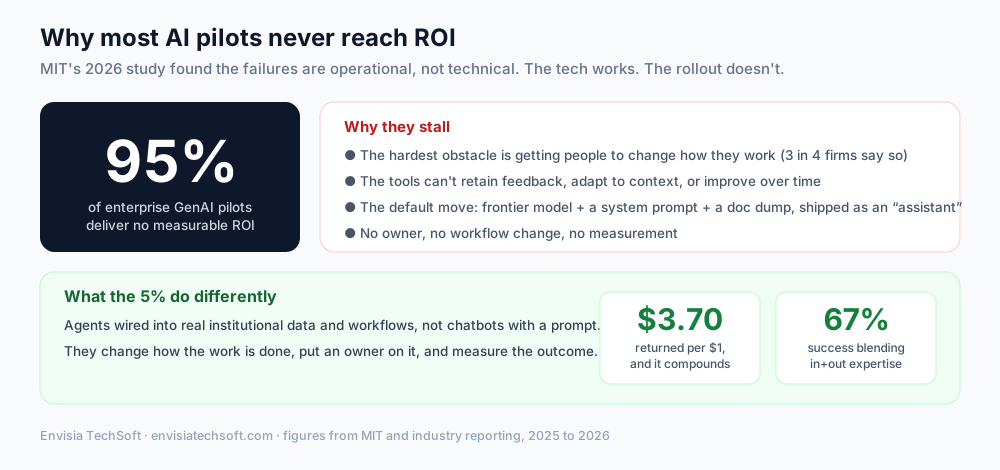
In 2026, MIT put a hard number on something a lot of executives already suspected. They studied enterprise generative-AI pilots and found that 95% of them delivered no measurable return on investment. Not "modest returns." No verifiable business value at all, against an estimated 30 to 40 billion dollars poured into enterprise AI.
The reflex is to blame the technology, and it is the wrong reflex. The models are extraordinary and getting better every quarter. The study's most important finding is that the failures are almost entirely operational, not technical. The tech works. The rollout does not. And once you see the pattern, it is almost embarrassingly consistent.
The default pilot, and why it dies
Here is the pilot that fails, and it fails the same way in company after company. Someone takes a frontier language model, writes a system prompt, points it at a pile of documents, and ships it to employees as an "AI assistant." A launch email goes out. Everyone tries it for a week. Then usage quietly craters, because the thing does not actually fit how anyone works.
Three failure modes hide inside that one pattern:
- Nothing changed about the work. The tool was bolted onto existing processes instead of changing them. People had to go out of their way to use it, so they stopped.
- The tool could not improve. A model with a prompt cannot retain feedback, adapt to context, or get better at your specific tasks over time. It is frozen on day one, so it never earns trust.
- Nobody owned it, and nobody measured it. No single person was accountable for the outcome, and no baseline existed to prove it helped, so it was easy to let it fade.
And underneath all of it, the obstacle three out of four companies name as the hardest: getting people to change how they work. That is not a technology problem. No model upgrade fixes it.
What the 5% actually do
The organisations that succeed are not the ones with the biggest budgets or the fanciest models. They share a small set of unglamorous habits.
They connect AI to real data and real workflows, not a prompt. The successful pattern is agents wired into actual institutional systems and processes, not a chatbot floating beside the work. The AI reaches into the tools people already use and does something inside the flow, rather than asking them to leave it.
They change how the work is done. The winners treat AI as a reason to redesign a process, not an accessory to the existing one. That is harder and slower up front, and it is the entire difference.
They put an owner on it and measure it. Someone is accountable for the outcome, a baseline exists, and the return is tracked. Successful deployments have reported around 3.70 dollars back for every dollar spent, and unlike a static tool, that return compounds as the system matures.
They blend inside and outside expertise. This one is striking in the data. Pilots that combined internal specialists with external expertise hit a 67% success rate, versus just 22% for internal-IT-only builds. Outside expertise brings the pattern; inside people bring the context. Neither wins alone.
| The 95% (failing) | The 5% (succeeding) |
|---|---|
| A chatbot with a system prompt | Agents wired into real data and workflows |
| Bolted onto existing processes | The process itself is redesigned |
| No owner, no baseline, no metric | A named owner and a measured outcome |
| Built by IT alone (22% success) | Internal plus external expertise (67%) |
| Ships and hopes | Changes how people actually work |
Why this is good news
If AI pilots failed for technical reasons, the fix would be out of your hands, waiting on the next model. Because they fail for operational reasons, the fix is entirely within your control. You do not need better AI. You need a better rollout.
That reframes the whole problem. The bottleneck was never the model's capability. It is the far more familiar work of change management: redesigning a process, assigning ownership, training people, and measuring the result. Boring, and it is exactly the boring that separates the 5% from everyone else.
Two of those levers we have written about directly, because they are where pilots most often live or die: driving adoption so people actually change how they work, and measuring the outcome instead of counting logins. Get those right and you are already doing what the successful minority does.
What to do before your next pilot
Before you fund another AI pilot, ask four questions, and do not proceed until you have real answers:
- What specific workflow will change, and who will have to work differently? If the answer is "none, it's just a helpful tool," it will fail.
- Who owns the outcome, by name? Not the technology, the business result.
- What is the baseline, and how will we measure the return? If you cannot measure it, you cannot prove it, and it will get cut.
- Do we have the right mix of internal context and external expertise, or are we handing it to IT alone and hoping?
The 95% is not a story about AI being overhyped. It is a story about organisations treating a people-and-process change as a technology purchase. Treat it as what it is, and you land in the 5%. That is the whole game, and it is more within reach than the headline suggests.
If you would rather not learn this the expensive way, designing the rollout, not just the tool, is exactly what we help teams do. Talk to us before the next pilot, not after.
Sources
Frequently asked questions
- What percentage of enterprise AI pilots fail?
- A widely cited 2026 MIT study found that 95% of enterprise generative-AI pilots fail to deliver measurable ROI, despite an estimated $30 to $40 billion invested in enterprise AI globally. The failures are overwhelmingly operational, not technical.
- Why do most AI pilots fail?
- Because they treat AI as a technology problem when it is a people-and-process problem. Three in four companies say the hardest obstacle is getting people to change how they work. The typical failed pilot is a frontier model with a system prompt pointed at a document library, shipped as an assistant, with no workflow change, no owner, and no measurement.
- What do the successful 5% do differently?
- They connect agents to real institutional data and workflows rather than shipping chatbots with a prompt, they actually change how the work gets done, they put a named owner on the outcome, and they measure it. Successful deployments have reported returns of around $3.70 for every dollar spent, and that return compounds as the system matures.
- Should companies build AI in-house or with outside help?
- The data favours a blend. Pilots that combined internal AI specialists with external expertise reported a 67% success rate, versus only 22% for builds handled by an internal IT team alone. Outside expertise plus inside context beats either on its own.