There is a whole genre of AI content built around one move: get you to place yourself on a maturity model, discover you are less mature than you would like, and feel a gentle urgency to buy something. It is easy to be cynical about it, and often correct to be.
But the underlying idea is sound, and quietly valuable, if you use it for the right purpose. An AI maturity assessment is not a report card to feel good or bad about. Used well, it answers a much more useful question: where, specifically, would AI fail in our organisation today if we tried to scale it? That is worth knowing before you spend the money, not after.
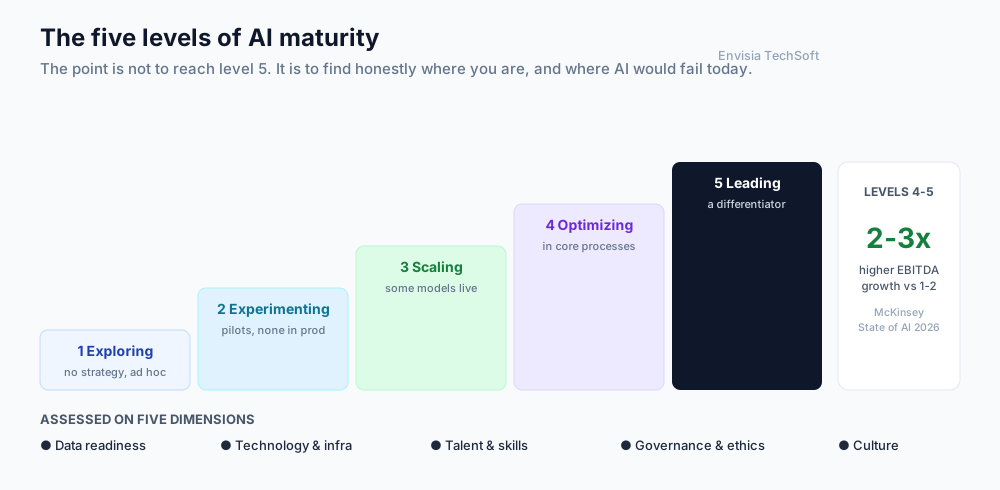
The five levels, in plain terms
Most credible frameworks converge on five levels. Here they are without the jargon:
- Exploring. No real AI strategy. A few people are tinkering, uncoordinated, with no shared direction.
- Experimenting. Multiple pilots are running, but none have made it into production. There is enthusiasm and there are gaps, usually in data and governance.
- Scaling. Some AI is genuinely live and used in production. Governance is emerging but still patchy and inconsistent.
- Optimizing. AI is woven into core business processes. The data pipelines are automated and governed, and it is part of how the work gets done.
- Leading. AI is a real competitive differentiator, operating at scale, making decisions in real time. Few organisations are genuinely here.
The value in naming the levels is not the label. It is that the jump between them is always blocked by something specific, and the model helps you find what.
The part that actually matters: the five dimensions
Here is where most people misuse maturity models. They want a single number, "we're a Level 2," and then argue about whether it should be a 3. That number is almost useless on its own, because maturity is not one thing.
A serious assessment scores you across five separate dimensions:
- Data readiness. Is your data accessible, clean, and governed, or scattered and untrustworthy?
- Technology and infrastructure. Can your systems actually support AI in production, or only in a demo?
- Talent and skills. Do your people, technical and non-technical, have the fluency to build and use it?
- Governance and ethics. Do you have the policies, controls, and oversight to deploy AI responsibly?
- Organisational culture. Will people actually adopt it, or quietly route around it?
The reason this matters: almost every organisation is uneven. You might have strong infrastructure and terrible data governance, or great talent and no culture of adoption. The single "level" hides exactly the imbalance that will sink your next project. The dimension view exposes it.
| Dimension | The question it answers | Common failure it exposes |
|---|---|---|
| Data readiness | Can we trust and reach our data? | Pilots that die on messy data |
| Technology | Will it survive production? | Demos that never scale |
| Talent & skills | Can our people build and use it? | Tools nobody adopts |
| Governance | Can we deploy it responsibly? | Blocked by legal or risk late |
| Culture | Will people actually use it? | Rollouts that quietly fail |
Why the honest version is worth it
Two things make a maturity assessment worth doing, and both require honesty that the sales-driven versions discourage.
First, it is diagnostic, not a trophy. The goal is not to prove you are a Level 4. It is to find the one dimension that is a Level 1 and is about to torpedo your ambitions. An organisation that scores itself generously learns nothing. One that scores itself brutally learns exactly where to spend next.
Second, the gap is real money. According to McKinsey's State of AI 2026, organisations at maturity levels 4 to 5 report two to three times higher EBITDA growth than those stuck at levels 1 to 2. That is not a rounding difference. It means maturity is a board-level business issue, not an IT housekeeping task, and that closing a specific dimension gap can move the actual numbers.
How to use it this quarter
You do not need a consultant and a six-week engagement to start. A useful first pass:
- Score each of the five dimensions separately, honestly, on the 1-to-5 scale. Get a few different functions to score independently, because leadership and the front line often disagree, and the disagreement is informative.
- Ignore the average. Find your lowest dimension. That is your binding constraint. It does not matter how mature your infrastructure is if your data or your culture is a 1.
- Aim to raise the lowest dimension by one level, not to become "AI-first" overnight. Maturity is climbed one honest step at a time.
The organisations that get real value from AI are not the ones with the most impressive maturity slide. They are the ones who looked honestly at where they would fail, fixed that specific thing, and only then scaled. Talent and skills are the dimension we most often see underrated, which is not a coincidence given what we do, but it is also genuinely where many otherwise-capable organisations stall.
If you want a candid read on where your organisation actually sits, and which gap to close first, that is a conversation we are happy to have. Reach out and we will walk through it with you.
Sources
Frequently asked questions
- What is an AI maturity model?
- An AI maturity model is a framework that describes how far an organisation has progressed in adopting and scaling AI, usually across five levels from isolated experiments to AI as a core competitive advantage. It gives leaders and technical teams a shared language to assess where they are and what is holding them back.
- What are the levels of AI maturity?
- A common five-level model runs: Level 1 Exploring (no strategy, ad hoc experiments), Level 2 Experimenting (pilots but none in production), Level 3 Scaling (some models live), Level 4 Optimizing (AI in core processes), and Level 5 Leading (AI as a genuine differentiator).
- What dimensions does an AI maturity assessment measure?
- Most credible assessments score five dimensions: data readiness, technology and infrastructure, talent and skills, governance and ethics, and organisational culture. A single overall level hides where the real gaps are, so the dimension-by-dimension view matters more than the headline score.
- Does AI maturity actually affect business results?
- Yes. According to McKinsey's State of AI 2026, organisations at maturity levels 4 to 5 report two to three times higher EBITDA growth than peers stuck at levels 1 to 2. The gap is large enough that maturity is a business issue, not just an IT one.