Search "AI for sales" and you will drown in tools promising to close deals while you sleep. It is a tempting fantasy and a misleading one. AI does not replace the salesperson, and there is no single magic product that runs your revenue. What AI actually does, and does very well, is take a specific, time-consuming task off your team's plate at each stage of the pipeline, so your people spend their hours selling instead of researching, drafting, and updating spreadsheets.
That reframing is the whole playbook. Stop looking for the one tool that does everything, and start asking, stage by stage, where your team wastes time on work a machine could do. The returns show up fast: around 86% of sales teams using AI report positive ROI within the first year, and 83% of AI-using teams saw revenue growth compared to 66% of those without.
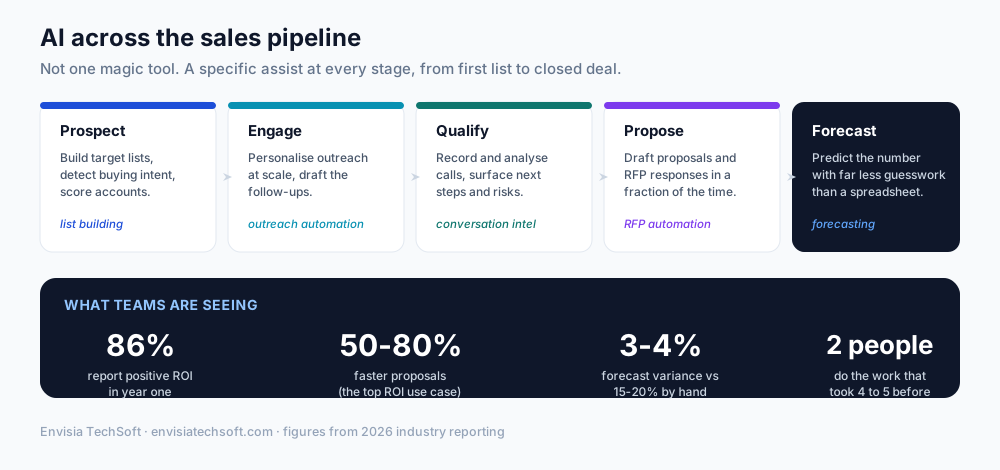
AI across the pipeline, stage by stage
Here is where the real value sits, from first touch to closed deal.
Prospect: build the list and find the intent
The top of the funnel is where reps burn hours, and it is the easiest to hand off. AI builds targeted prospect lists, detects buying intent from behavioural signals, and scores accounts so your team spends time on the ones most likely to buy rather than working an alphabetical list. The impact is concrete: companies scoring accounts this way have reported dramatically higher opportunity open rates and roughly double the conversion on well-scored accounts.
Engage: personalise outreach at scale
Generic outreach gets ignored, and genuine personalisation does not scale by hand. This is a perfect fit for AI: draft outreach and follow-ups tailored to each prospect using what you actually know about them, so every message reads like it was written for one person, because in effect it was. The rep reviews and sends rather than writing from a blank page.
Qualify: let the calls analyse themselves
Conversation intelligence records and analyses sales calls, then surfaces the next steps, the risks, and what the buyer actually cared about. Instead of a rep half-remembering a call and scribbling notes, the team gets a reliable summary and a nudge on what to do next, and managers get visibility into what is working across the floor.
Propose: the highest-ROI use case
If you do one thing, do this. Proposal and RFP automation is where teams see the biggest documented return in 2026: a 50 to 80% reduction in response time and a 40 to 60% increase in capacity without adding a single person. RFPs are painful, repetitive, and exactly the kind of structured drafting AI excels at. Freeing your best sellers from writing documents so they can sell is close to pure upside.
Forecast: replace the guesswork
Manual forecasting is a spreadsheet and a gut feeling, and it shows: manual methods typically land 15 to 20% off actual revenue. AI forecasting, drawing on the real signals in your pipeline, gets that variance down to 3 to 4%. For a leader trying to plan hiring, targets, and cash, that accuracy is worth a lot on its own.
What the returns actually look like
The stage-by-stage gains add up to something structural. The headline is not "each rep is 10% faster." It is that the shape of the team changes. A two-person team equipped with AI prospecting, AI-assisted outreach, and call recording can now cover pipeline that previously needed four or five people. That is not a productivity tweak, it is a different operating model, and it is why the AI-in-sales market is growing at roughly 33% a year.
| Stage | The AI assist | What teams report |
|---|---|---|
| Prospect | List building, intent, scoring | Higher open and conversion rates |
| Engage | Personalised outreach at scale | More replies, less rep time |
| Qualify | Conversation intelligence | Better follow-through, manager visibility |
| Propose | Proposal and RFP automation | 50 to 80% faster, 40 to 60% more capacity |
| Forecast | AI forecasting | 3 to 4% variance vs 15 to 20% manual |
How to actually roll this out
The mistake is buying five tools and hoping. The better path is the same discipline that separates successful AI projects from failed ones:
- Start with the highest-ROI, most-hated task. For most teams that is proposals or manual outreach. Fix one painful stage first and let the win build credibility.
- Keep the rep in the loop. AI drafts, the human reviews and sends, especially on anything a customer sees. Trust is earned over a few weeks.
- Measure the right thing. Not "did we buy AI" but time saved per rep, reply rates, and pipeline covered per head. Adoption that does not change these numbers is not working, which is the core lesson of measuring AI ROI properly.
- Train the team, do not just license the tool. The gap between a team that has AI and a team that uses it well is enormous, and it comes down to enablement, not software.
That last point is the one leaders underestimate most. The tools are necessary and nowhere near sufficient. The teams pulling ahead are the ones whose reps actually know how to work with AI, which is exactly the kind of role-specific training we build. If your revenue team has the licences but not the fluency, let's talk about closing that gap.
Sources
Frequently asked questions
- How is AI actually used in sales?
- Across the whole pipeline, not in one place. The main categories are prospecting and list building, intent detection, personalised outreach at scale, conversation intelligence from recorded calls, proposal and RFP automation, and forecasting. Each targets a specific, time-consuming task rather than trying to replace the salesperson.
- Does AI in sales actually deliver ROI?
- For most teams, yes. Around 86% of sales teams using AI report positive ROI within their first year, and 83% of AI-using sales teams saw revenue growth versus 66% of teams without AI. The strongest returns come from proposal and RFP automation, where teams report 50 to 80% faster responses.
- What sales task should you automate with AI first?
- Start where the ROI is highest and clearest, which is usually proposal and RFP automation or personalised outreach. Proposal automation alone tends to cut response time by 50 to 80% and lift capacity by 40 to 60% without adding headcount, so it frees senior sellers to sell instead of writing documents.
- Will AI replace salespeople?
- It is shifting what salespeople spend time on rather than replacing them. AI handles the repetitive research, drafting, and admin, so a smaller team covers more pipeline: a two-person team with AI prospecting and outreach can now cover what used to take four or five people. The human still owns the relationship, the judgment, and the close.