Here is a scene that plays out in a lot of companies. The AI training wraps up. HR reports back: 94% completion, an average satisfaction score of 4.6 out of 5, hundreds of hours of learning delivered. Everyone nods. The box is ticked.
And not one of those numbers tells you whether the training was worth a single rupee or dollar. Completion is not ROI. Satisfaction is not ROI. Hours logged is the opposite of ROI, it is a cost. The uncomfortable truth is that most organisations measure AI training with metrics designed for compliance courses, where the only goal was that everybody finished. AI training has a completely different goal: to change how people actually work. And you cannot see that in a completion rate.
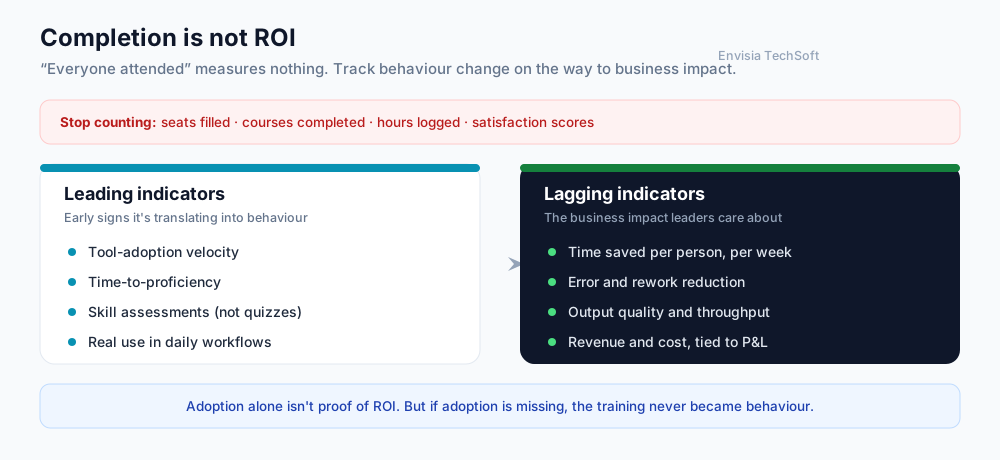
Stop counting the vanity metrics
The first move is to stop treating activity as achievement. These four numbers feel like measurement and measure nothing that matters:
- Seats filled and courses completed tell you the training happened, not that it worked.
- Hours logged is time spent, which is a cost, not a benefit.
- Satisfaction scores tell you people enjoyed it, which is weakly correlated, at best, with whether they changed anything.
None of these are useless for running a training program. They are just useless as evidence of return. Report them if you like, but never mistake them for ROI.
The two kinds of indicator that actually matter
Real measurement tracks the journey from "we trained them" to "the business is better off," and that journey has two stages: leading and lagging indicators.
Leading indicators are the early signals that training is turning into behaviour. You can see these within weeks:
- Tool-adoption velocity. How quickly are people actually integrating AI into their daily work after the training?
- Time-to-proficiency. How long until someone can reliably do a real task with AI, measured by a practical assessment, not a quiz?
- Real use in workflows. Is the AI showing up in the actual work, or only in the training sandbox?
Lagging indicators are the business results that follow, and they are what leaders ultimately care about:
- Time saved per person, per week, on specific tasks.
- Error and rework reduction in the work the training targeted.
- Output quality and throughput.
- Revenue and cost, tied as directly as you can manage to the P&L.
The reason you track both is timing. Lagging indicators are the truth, but they arrive slowly. Leading indicators arrive fast and predict them. If adoption velocity is flat six weeks in, you already know the productivity gains are not coming, and you can intervene before you have wasted two quarters waiting for a return that was never going to show up.
| Leading (weeks) | Lagging (months) |
|---|---|
| Tool-adoption velocity | Time saved per person |
| Time-to-proficiency | Error and rework reduction |
| Practical skill assessments | Output quality and throughput |
| Real use in daily workflows | Revenue and cost, tied to P&L |
The adoption signal, read correctly
There is a subtle trap in adoption metrics worth naming, because people fall into it in both directions.
Adoption on its own is not sufficient proof of ROI. People can use a tool enthusiastically and produce no more value than before, or even less if it distracts them. Usage is not outcome.
But the absence of adoption is a strong signal that the training failed. If people are not using AI in their work after you trained them, the training did not translate into behaviour, full stop, and no downstream business result is coming. So read adoption as a necessary early warning light, not a finish line. High adoption does not guarantee ROI; low adoption guarantees its absence.
A practical way to measure your next program
You do not need a research department to do this well. A workable approach:
- Set a baseline before you train. Pick two or three specific tasks the training targets, and measure how long they take and how often they go wrong, now. Without a baseline, you can never prove a change.
- Watch leading indicators from week one. Track adoption and real use immediately. If they are weak, fix the rollout now, do not wait for the lagging numbers.
- Connect to the P&L at the quarter mark. Translate time saved and errors avoided into money, in the language your finance team uses. "Twelve hours a month saved across forty people" becomes a number a CFO recognises.
- Report the chain, not the completion. Show the story: we trained, adoption rose, proficiency followed, and here is the measured business result. That is what earns the next budget.
This is also why training and rollout cannot be separated. Training that is not followed by adoption produces no return, which is the same reason most AI pilots fail, and adoption is a discipline of its own that we have written about here. Measure the whole chain and you will know, early and honestly, whether the money is working.
Designing AI training that is built to change behaviour, and to be measured, is the core of what we do. If "everyone attended" is the best number you currently have, let's talk about what to measure instead.
Sources
Frequently asked questions
- How do you measure the ROI of AI training?
- By tracking behaviour change and business impact, not attendance. Use leading indicators like tool-adoption velocity, time-to-proficiency, and real use in daily workflows, then connect them to lagging indicators like time saved, error reduction, quality, and eventually revenue or cost tied to the P&L. Completion and satisfaction scores measure activity, not return.
- Why aren't completion rates a good measure of training ROI?
- Completion rates were designed for compliance training, where the goal is that everyone finished. AI training aims to change how people work. Someone can complete a course and change nothing. Completion tells you the training happened; it says nothing about whether it produced any value.
- What are leading vs lagging indicators for AI training?
- Leading indicators are early signs that training is turning into behaviour: adoption velocity, time-to-proficiency, practical skill assessments, and real use in workflows. Lagging indicators are the business results that follow: time saved per person, error and rework reduction, output quality, and revenue or cost impact. Track both, because leading indicators tell you early whether the lagging ones will ever arrive.
- Is AI tool adoption enough to prove training worked?
- Adoption on its own is not sufficient proof of ROI, because usage does not guarantee value. But the absence of adoption is a strong signal that the training failed to translate into behaviour. So adoption is a necessary early indicator to watch, not the final answer.