The hardest part of an AI strategy is not choosing the tools, negotiating the licences, or even running the training. It is the part that comes after, when you discover that most of your organisation is still not using any of it. The enthusiasts are flying. Everyone else is politely ignoring the whole thing. This is where AI strategies quietly die, and it is worth understanding why, because the reason is almost never the one people reach for.
Adoption does not fail because the technology is bad. It fails because getting a whole organisation of humans to change how they work is genuinely hard, and most companies dramatically underestimate it. The good news, as with why most pilots fail, is that a human problem has human solutions, and the data on what works is unusually clear.
The real barriers, in order
Before you fix adoption, know what you are actually fighting. The barriers are rarely technical:
- Low awareness, first and worst. The most common blocker is simply that people do not understand how AI applies to their job. Understanding is low, so people disengage before they ever get to the later stages. If someone cannot see what it does for them, no licence will move them.
- Uncertainty and quiet fear. People are unsure how AI will change their role, their responsibilities, even their job security. Underestimate that human anxiety and you get resistance, often unspoken.
- Absent leadership. If leaders are not visibly using and backing AI, employees read that as permission to wait. And most managers are not stepping up here, which we will come to.
- Data and access friction. Sometimes the tool genuinely does not reach the data or fit the workflow, and people are right to abandon it.
The single biggest lever: leadership
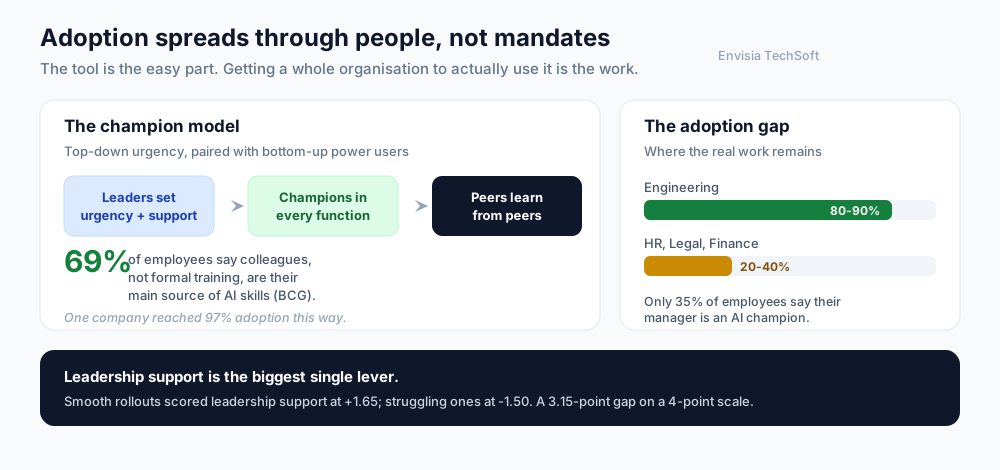
If you change one thing, change this. The evidence on leadership support is stark. In one analysis, organisations with smooth AI rollouts scored leadership support at +1.65, while struggling ones scored -1.50. That is a 3.15-point spread on a four-point scale, which is enormous. Leadership is not one factor among many. It is close to the whole story.
And here is the gap it exposes: only 35% of employees say their manager is an AI champion. Two-thirds of managers, in other words, are not visibly modelling the behaviour they need their teams to adopt. You cannot mandate a change you are not seen to be making yourself. The most powerful adoption move a leader can make is to use the tools publicly, talk about what they are learning, and make it unmistakably clear that this matters.
The most scalable lever: champions
Leadership sets the tone from the top. Champions spread it through the middle, and this is where adoption actually scales.
An AI champion network is simple: identify the power users inside each department, the people who have become genuinely fluent and, crucially, who carry credibility with their peers. Then support them to help their colleagues learn. The reason this works is one striking statistic: BCG found that 69% of employees cite colleagues, not formal training, as their primary source of AI skills. People learn this from the person at the next desk who already gets it, far more than from a course.
That means your champions are more effective adoption drivers than your training program alone, because they have something no IT mandate ever will: peer credibility. When the respected analyst in finance shows the team a workflow that saved her an afternoon, that lands in a way no top-down rollout can. One company reached 97% adoption precisely by pairing top-down urgency with bottom-up champions in every function.
Mind the gap between your teams
There is one more pattern worth planning around, because it catches leaders by surprise. AI adoption is deeply uneven across functions. Engineering teams in mature organisations often run at 80 to 90% meaningful adoption. Business functions like HR, Legal, and Finance frequently sit at 20 to 40%. If you measure adoption as a single company-wide number, you will miss this entirely and celebrate an average that hides a huge divide.
The technical teams got there on their own because they had the fluency, obvious use cases, and a peer culture around the tools. The business functions will not close that gap by osmosis. They need deliberate enablement: champions inside their function, use cases framed in their language, and training built for non-technical roles rather than borrowed from the engineering one. Adoption is not one program. It is a different push for each part of the org.
A playbook that works
Putting it together, here is the shape of an adoption effort that actually moves the number:
- Lead visibly from the top. Leaders use the tools in the open and make the priority unmistakable. Nothing substitutes for this.
- Build a champion network. Find the credible power user in every function and give them time, recognition, and a little structure to help their peers.
- Lead with awareness, not tools. Start by showing people what AI does for their specific job. Awareness is the first barrier; clear it before you push the tool.
- Close the gaps deliberately. Track adoption per function, not just company-wide, and give the lagging business teams their own tailored enablement.
- Address the fear honestly. Be straight about how roles will change. Uncertainty left unspoken becomes quiet resistance.
The organisations that win with AI are not the ones with the best tools. They are the ones that treated adoption as the real work, led it visibly, and let credible peers carry it through the building. That is a skill, and it is a teachable one.
Building champion networks and function-specific enablement is a core part of how we help organisations move from a few enthusiasts to genuine, measured adoption. If your licences are being under-used, let's talk about closing the gap.
Sources
Frequently asked questions
- Why is AI adoption so hard in large organisations?
- Because adoption is a human problem, not a technical one. The most common barrier is low awareness: people do not understand how AI applies to their work, so they disengage before they ever try. Add uncertainty about job impact and a lack of visible leadership support, and even good tools go unused. The technology is rarely the blocker.
- What is the champion model for AI adoption?
- The champion model pairs top-down urgency from leadership with bottom-up power users, called champions, in every function. Champions are respected colleagues who have become fluent and help their peers learn. It works because BCG found 69% of employees cite colleagues, not formal training, as their main source of AI skills, so peer champions spread adoption faster than courses alone.
- How much does leadership support matter for AI adoption?
- It is the single biggest lever. In one analysis, organisations with smooth AI rollouts scored leadership support at +1.65, while struggling ones scored -1.50, a 3.15-point gap on a four-point scale. Yet only 35% of employees say their manager is an AI champion, which is why so many rollouts stall.
- Why do technical teams adopt AI faster than business teams?
- Engineering teams in mature organisations often run at 80 to 90% meaningful AI adoption, while business functions like HR, Legal, and Finance sit at 20 to 40%. Technical teams have the fluency, the immediate use cases, and the peer culture around the tools. Business functions need deliberate enablement, champions, and use cases framed in their own language to close the gap.