Most executives have the same quiet worry about AI: that they are falling behind, that everyone else understands it better, and that they will make an expensive decision based on a demo they did not really follow. The instinct is to fix this with a course. Then they open one, hit a wall of Python and linear algebra, and quietly close the tab.
That is the wrong course. A leader does not need to build AI. A leader needs the judgment to decide whether to build it, where, at what risk, and how to get the organisation to actually use it. That judgment is learnable, and it does not take a semester. It takes about a day.
The urgency is real, to be clear. In a PwC survey of thousands of executives, 73% said that failing to adopt AI within one to three years would put them at a serious competitive disadvantage. But urgency without literacy just produces expensive mistakes, and literacy for a leader looks nothing like literacy for an engineer.
What "literacy" means for a leader
Strip away the hype and executive AI literacy comes down to four capabilities:
- Knowing what AI can and cannot do. Understanding the difference between generative, predictive, and autonomous AI, and having a realistic sense of where each is strong and where it quietly fails.
- Spotting real opportunities. Being able to look at your own operation and tell a genuine, valuable use case apart from an expensive distraction that sounds impressive in a board deck.
- Evaluating claims critically. Sitting across from a vendor promising the moon and knowing which questions cut through it.
- Managing the risk and the change. Understanding the governance, the data and security exposure, and the human side of getting people to adopt it.
Notice what is not on that list: how a transformer works, how to fine-tune a model, how to write a prompt in code. Those matter for your teams. They are not what makes you a better decision-maker.
The 8-hour plan
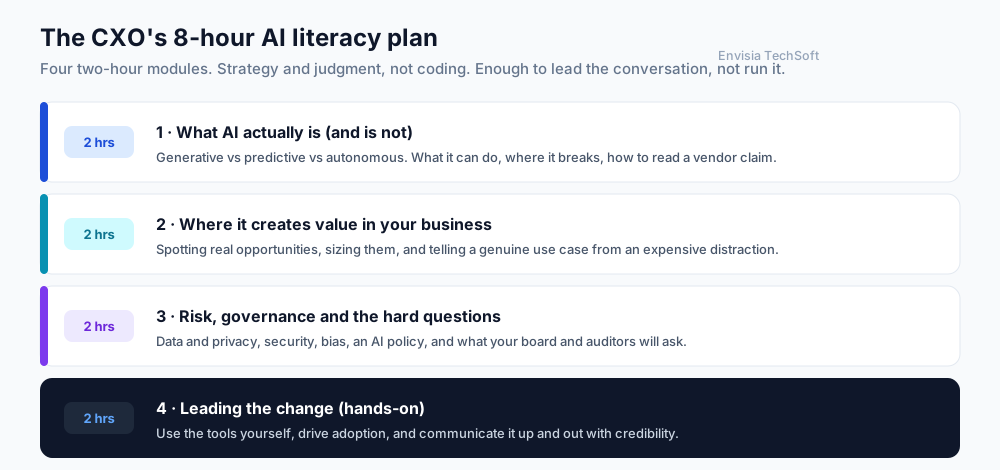
Here is how we structure it, in four two-hour modules. It is deliberately short. The goal is a leader who can lead the conversation, not one who can run the model.
Module 1: What AI actually is, and is not (2 hours)
The foundation. The three types of AI in plain terms, what today's systems genuinely do well, and where they break, hallucinate, or mislead. Crucially, this is where you learn to read a vendor claim: when someone says "our AI is 99% accurate," you will know to ask "accurate at what, measured how, on whose data." That single skill pays for the whole day.
Module 2: Where it creates value in your business (2 hours)
Generic AI training fails leaders because it stays generic. This module is about your operation: which processes are repetitive and rules-light enough to automate, where AI augments your best people versus where it just adds noise, and how to size an opportunity before you fund it. You leave with a shortlist of real candidates, not a vague sense that you "should do something with AI."
Module 3: Risk, governance, and the hard questions (2 hours)
The part most programs skip and most boards care about most. Data and privacy exposure, security risks like prompt injection, bias, and what a responsible rollout requires. You also cover what your auditors, regulators, and board will ask, and why not having an AI policy is now treated as a governance failure in itself.
Module 4: Leading the change, hands-on (2 hours)
Reading about AI does not make you fluent any more than reading about swimming does. This module is hands-on: you use the tools yourself on your own work, so you understand from the inside what your teams are experiencing. Then it covers the thing that actually decides success, driving adoption across the organisation, and communicating your AI strategy up to the board and out to the market with credibility.
What to learn, and what to skip
The discipline of a good executive program is as much about what it leaves out. Here is the line we draw:
| Worth your time | Safe to skip |
|---|---|
| What AI can and can't do | How neural networks work mathematically |
| Reading vendor claims critically | Writing code or prompts as a developer |
| Spotting and sizing opportunities | Model architectures and training methods |
| Governance, risk, and policy | Tuning and deploying models yourself |
| Driving adoption and change | The latest benchmark leaderboard |
| Using the tools hands-on | Building the pipeline behind them |
Why eight hours, and not eighty
The research is consistent: basic AI fluency lands in about 4 to 6 hours, and a comprehensive strategic grasp takes 10 to 15. Eight hours is the deliberate middle. It is enough for a leader to make informed calls, ask the right questions, and lead with confidence, without drifting into detail that belongs to their teams. Go shorter and it stays superficial. Go much longer and you are training an executive to do a job that is not theirs.
The leaders who get the most from AI are rarely the most technical. They are the ones who understand it well enough to make good decisions, set a clear direction, and get their organisation to move. That is what eight focused hours buys you.
This is exactly the ground our gold-tier CXO program covers, tailored to your industry and your actual use cases. If your leadership team is at the "we know we should, but we're not sure how" stage, get in touch and we will design a session around where you are.
Sources
Frequently asked questions
- Do executives need to learn to code to be AI-literate?
- No. Executive AI literacy is about strategy, judgment, and governance, not writing code. Leaders need to understand what AI can and cannot do, spot genuine opportunities, evaluate vendor claims, and manage the risks. The technical build is for their teams.
- How many hours does executive AI literacy take?
- Basic AI fluency takes roughly 4 to 6 hours, and a comprehensive strategic understanding takes 10 to 15 hours. An 8-hour plan sits in the sweet spot for a busy leader: enough to make informed decisions and lead the conversation, without going deeper than the role requires.
- Why does AI literacy matter for leaders now?
- In a PwC survey of thousands of executives, 73% said that failing to adopt AI within one to three years risks a significant competitive disadvantage. Leaders make the investment, governance, and adoption decisions, so their literacy sets the ceiling on what the whole organisation can do with AI.
- What should an executive AI program cover?
- Four areas: what AI actually is and is not, where it creates real value in your specific business, the risks and governance around it, and how to lead the change including hands-on use of the tools. Skip the maths and the model internals.