Contract review is one of the least glamorous and most important jobs in any business. Someone has to read the fine print, spot the clause that quietly shifts all the liability onto you, check that it doesn't breach a regulation, and do it across dozens or hundreds of documents. It's slow, it's costly, and it's precisely the sort of pattern-heavy, high-volume work that AI turns out to be genuinely good at.
Legal teams have noticed. In 2026, AI contract analysis has moved from novelty to normal, and the interesting part isn't that it's fast. It's how the work gets divided: the AI does the exhaustive first pass across everything, and the lawyer keeps the judgment on what actually matters. Done right, that's not lawyers being replaced. It's lawyers stopping spending their expensive hours reading boilerplate.
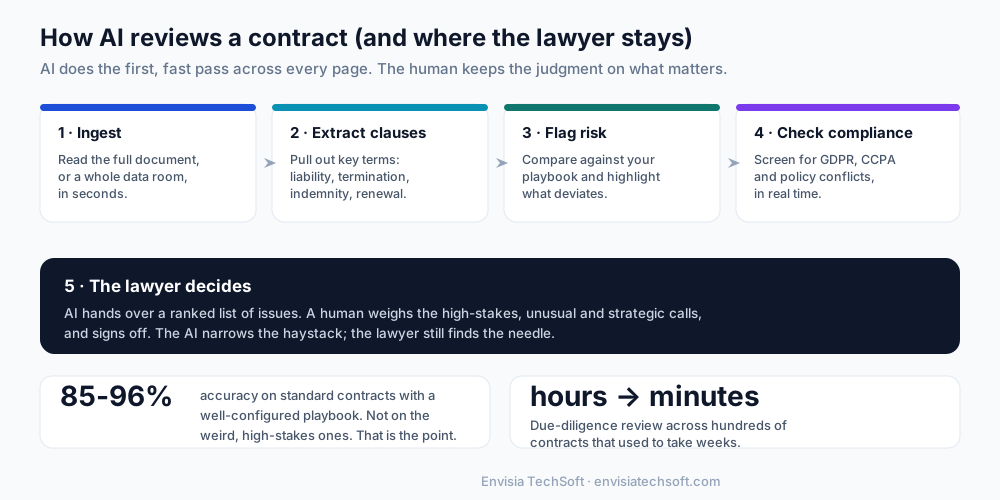
What the AI actually does
A modern contract-analysis tool runs a document, or an entire data room, through a pipeline that mirrors what a junior associate would do, only faster and without getting tired on page 300.
- Ingest. It reads the full document in seconds, and can chew through hundreds of contracts in the time a person reads one.
- Extract clauses. It pulls out the key terms, liability, indemnity, termination, renewal, payment, and organises them so nothing's buried.
- Flag risk. It compares what it found against your firm's playbook, your standard positions and red lines, and highlights every clause that deviates.
- Check compliance. It screens for conflicts with regulations like GDPR or CCPA, and increasingly does this in real time, flagging clauses that may run afoul of current or upcoming rules.
- Hand off to a human. It presents a ranked list of issues, and a lawyer makes the calls that need judgment.
That last step is the whole philosophy. The AI narrows the haystack. The lawyer still finds and weighs the needle.
Where it's making the biggest difference
Three use cases are where legal teams get the most value today:
- Due diligence. This is the killer application. In an acquisition, someone has to review every contract the target company holds, looking for change-of-control clauses, unusual liabilities, and hidden commitments. Tools built for this, with thousands of pre-trained extraction fields, turn weeks of associate time into a structured report in hours.
- Everyday contract review. NDAs, vendor agreements, and standard commercial contracts get a first-pass review in seconds, with risky clauses flagged and improvements suggested, so a lawyer starts from a marked-up draft instead of a blank read.
- Compliance monitoring. As regulations shift, AI can re-scan a contract portfolio to find clauses that are now non-compliant, a job that's simply impractical to do by hand at scale.
The accuracy question, answered honestly
Any lawyer's first question is: can I trust it? The honest answer is nuanced, and the nuance is the important part.
On standard contracts, with a well-configured playbook, modern tools reach 85 to 96% accuracy. That's genuinely useful, and it's why the technology has taken off. But read that sentence carefully, because every qualifier is load-bearing:
- "Standard contracts." The AI excels at the common, well-structured agreements it has effectively seen a thousand versions of. On a bespoke, unusual, or highly specialised contract, its footing gets much less sure.
- "Well-configured playbook." The accuracy isn't magic; it depends on the tool being set up with your firm's actual standards and positions. Garbage playbook, garbage flags.
- "85 to 96%." Even at the top of that range, one in twenty-odd judgments needs a human. On a high-stakes deal, that's not a rounding error you ignore. It's exactly why the lawyer stays.
So the framing that works is: AI for the standard, human for the unusual and the high-stakes. The tool is a powerful assistant that makes an expert faster, not a replacement for the expert's judgment on the calls that carry real risk.
The tools, briefly
The market has segmented by user, and you don't need to memorise it, just know the shape:
| Tier | Who it's for | Examples |
|---|---|---|
| Enterprise CLM and due diligence | Large firms and legal departments | Ironclad, Kira, Luminance |
| Contract lifecycle plus AI review | Mid-size legal and business teams | Juro and similar platforms |
| Lightweight review | Solos, startups, small teams | Budget tools from around $12 a month |
The gap between the top and bottom tiers is less about raw capability now and more about integration, security, and how deeply the tool plugs into the rest of your legal workflow.
Getting it right (and staying out of trouble)
If your team is bringing AI into contract work, a few principles keep it valuable and safe:
- Configure the playbook properly. This is where the accuracy comes from. Invest the time to encode your firm's real standards, or you'll get confident flags on the wrong things.
- Keep a lawyer accountable for every material decision. The AI advises. A qualified human decides and signs off, especially on anything unusual or high-value. This isn't just good practice; it's the line that keeps you out of professional-responsibility trouble.
- Mind confidentiality. Contracts are sensitive. Understand where the tool sends your data, and for the most sensitive work, favour tools with strong security guarantees or models you can run in your own environment.
- Treat it as leverage, not autopilot. The win is that your best lawyers spend their time on the hard, valuable questions instead of drowning in boilerplate. That's the goal to optimise for.
The bottom line
AI contract analysis is one of the clearest, most mature business applications of the technology in 2026, precisely because it plays to AI's strengths (exhaustive, fast, pattern-matching work) while leaving humans the part they're irreplaceable for (judgment on what matters and accountability for the call). The firms getting value aren't the ones who handed review to a machine. They're the ones who let the machine do the reading so their lawyers could do the lawyering.
Sources
Frequently asked questions
- How are legal teams using AI for contract analysis?
- They use it to read contracts at speed, extract key clauses and dates, flag risky or missing terms, and compare agreements against a standard playbook. It handles the first-pass review that used to consume hours of a lawyer's time.
- Is AI accurate enough for legal work?
- It is useful but not infallible. AI is strong at surfacing and summarising relevant clauses, but it can miss nuance and occasionally get things wrong, so a qualified person must review its output. It speeds up the work rather than replacing legal judgment.
- Where does AI make the biggest difference in legal teams?
- In high-volume, repetitive review: due diligence, contract intake, obligation tracking, and compliance checks against a set of rules. These are the tasks where speed matters most and where human review can still catch the exceptions.
- What are the risks of using AI in legal work?
- The main risks are over-trusting output, the confidentiality of the documents you feed it, and hallucinated or missed terms. Keeping a lawyer in the loop, using tools with proper data protection, and treating AI as a first pass rather than the final word keeps you out of trouble.