If you'd asked in 2024 whether to build your product on an open-source model or a closed one like GPT or Claude, the honest answer was "closed, unless you have a specific reason not to." The proprietary models were clearly ahead, and the open models were a fun project rather than a serious foundation for most businesses.
That answer is now out of date. The gap has closed to the point where, for a lot of real-world work, an open model is genuinely competitive. So the decision has become the more interesting kind: not "which is better" but "which trade-offs fit your situation." Let's look at where things actually stand, without the tribalism that tends to attach to this debate.
First, the gap really did close
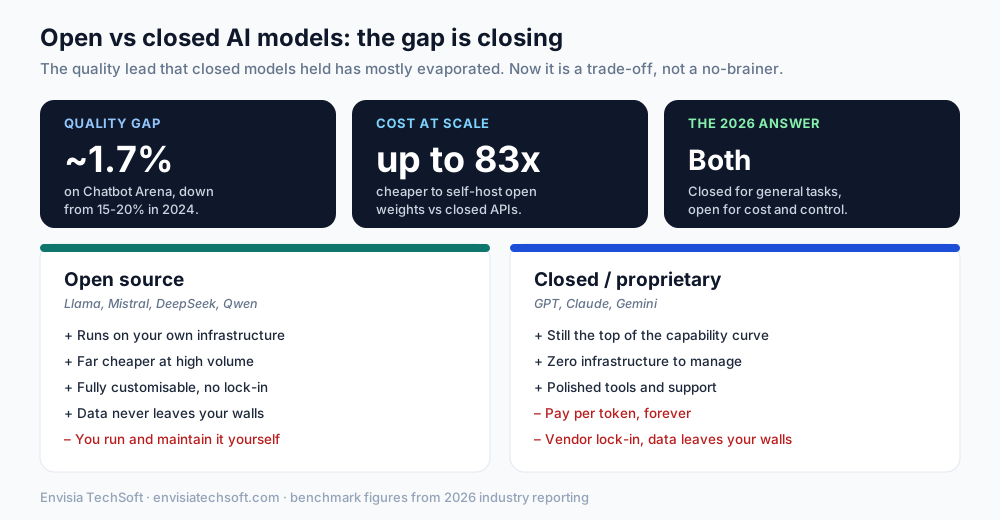
This is the fact that reframes everything, so it's worth stating plainly. The quality lead that closed models held has collapsed. On Chatbot Arena, a widely-watched head-to-head ranking, the gap between the best open and best closed models has narrowed to around 1.7%, down from a commanding 15 to 20% in 2024.
On specific benchmarks the story is the same. Open models like DeepSeek and Llama now match or beat the leading closed models on a majority of standard tests, and on coding tasks the difference has shrunk to a few percentage points. Part of what made this possible is architecture: DeepSeek's mixture-of-experts design, for instance, delivers frontier-class performance while only activating a fraction of its parameters per query, which keeps the compute cost down.
The takeaway isn't that open models have "won." Closed models still tend to hold the very top of the capability curve on the hardest tasks. It's that the difference is now small enough that, for most everyday work, it isn't the deciding factor anymore. Which means the other factors, cost, control, and convenience, move to the front.
What each side is genuinely better at
Strip away the ideology and the two options have a clean set of strengths.
Open-source models (Llama, Mistral, DeepSeek, Qwen) win on:
- Cost at scale. This is the big one. Self-hosting an open model can be dramatically cheaper at high volume, with reports of up to an 83x cost reduction versus closed APIs for heavy usage. If you're running a billion tokens a month, that gap is the whole business case.
- Control and privacy. You can run the model on your own infrastructure, which means your data never leaves your walls, a decisive factor in healthcare, finance, and legal.
- Customisation. You can fine-tune the weights, inspect the model, and shape it to your domain without asking anyone's permission.
- No lock-in. You're not hostage to a vendor's price changes, deprecations, or terms.
Closed / proprietary models (GPT, Claude, Gemini) win on:
- Peak capability. For the hardest reasoning, they're still usually a step ahead.
- Zero operational burden. No infrastructure to run, scale, or maintain. You call an API and it works.
- Polish and support. Mature tooling, documentation, safety features, and someone to call.
Here's the same split side by side:
| Factor | Open source | Closed / proprietary |
|---|---|---|
| Peak capability | Very close, slightly behind | Still leads on the hardest tasks |
| Cost at scale | Far cheaper (self-hosted) | Pay per token, adds up fast |
| Data privacy | Stays on your infrastructure | Leaves your walls to the vendor |
| Customisation | Full, fine-tune freely | Limited to what the API allows |
| Operational effort | You run and maintain it | None, it's someone else's job |
| Vendor lock-in | None | Real |
The honest cost of "free"
Open-source is often described as free, and that word does some misleading work. The model weights are free. Running them is not. When you self-host, you take on the infrastructure, the scaling, the reliability, and the engineering time to keep it all working. For a team without that capability, a closed API's "just call it" simplicity can easily be worth its per-token price.
So the real comparison isn't "free versus paid." It's "cheaper per token but you operate it" versus "more per token but zero operational burden." Which side of that trade wins depends entirely on your volume and your team. High volume with engineering muscle tilts open. Low or spiky volume without a platform team tilts closed.
The answer most teams land on: both
Here's where the tribal framing really falls apart. In practice, the 2026 question is rarely "one or the other." Most serious AI deployments use both, matched to the job:
- Closed models for general, low-volume, or hardest tasks, where peak capability and zero-ops convenience matter most.
- Fine-tuned open models for high-volume, cost-sensitive, or privacy-critical workflows, where control and per-token economics dominate.
It's the same logic as the RAG versus fine-tuning debate: the sophisticated answer is a portfolio, not a purity test. You route the work to whichever model fits its economics and requirements.
How to actually decide
A few questions cut through it fast:
- What's your volume? Low or unpredictable favours a closed API. High and steady makes open self-hosting's cost advantage compelling.
- How sensitive is your data? If it genuinely cannot leave your environment, that alone can decide it: open, self-hosted.
- Do you have the engineering to run it? Be honest. Self-hosting is real operational work. No platform team tilts you toward closed, at least to start.
- How hard are your tasks? If you're pushing the frontier of reasoning, the closed models' remaining edge may matter. For most business tasks, it won't.
The strategic reality of 2026 is that you no longer have to choose a side and defend it. The open models got good enough that the decision is now about fit, and the smartest teams treat these as tools in a kit rather than teams to root for. Pick the right model for each job, keep your options open, and don't pay a frontier price for work a cheaper model does just as well.
Sources
Frequently asked questions
- Are open-source AI models as good as closed ones?
- For most everyday tasks, yes. The quality gap between the best open and closed models has narrowed to around 1.7% on Chatbot Arena, down from 15 to 20% in 2024. Closed models still tend to lead on the very hardest reasoning, but the difference is now small enough that it is rarely the deciding factor.
- Is open-source or closed AI cheaper?
- Open-source is far cheaper at high volume. Self-hosting an open model can cost dramatically less than a closed API, with reports of up to 83x savings for heavy usage. But open source is not free to run: you take on the infrastructure and engineering. Low or spiky volume without a platform team often makes a closed API's convenience worth its per-token price.
- Should I use open-source or closed AI models?
- Most serious teams use both. Closed models suit general, low-volume, or hardest tasks where peak capability and zero operations matter. Fine-tuned open models suit high-volume, cost-sensitive, or privacy-critical work where control and economics dominate. Decide per job based on your volume, data sensitivity, engineering capacity, and task difficulty.
- What are the main open-source AI models?
- The leading open-weight families are Llama, Mistral, DeepSeek, and Qwen. They trail slightly on frontier capability but lead on customisability, on-premises deployment, cost at scale, and freedom from vendor lock-in.