It's easy to think of AI as something that happens in the cloud, which is a comforting word that makes it sound weightless. It isn't. Every prompt you send runs on a real chip, in a real server, in a real building, and that building draws electricity from a grid and water for cooling. Multiply that by billions of requests a day and a global race to build ever-larger models, and "the cloud" turns out to have a very physical footprint.
This is the part of the AI story that gets less airtime than the capabilities, and it deserves an honest look. Not a doom sermon, and not the hand-waving that pretends it's all fine. Just the numbers, what's being done about them, and where the hard trade-offs really sit.
The energy: the number that dwarfs the rest
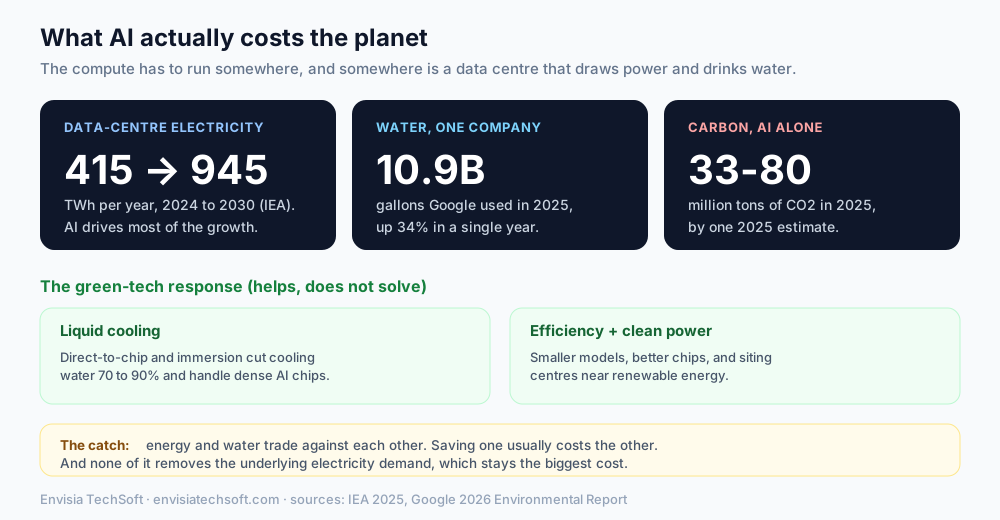
Electricity is the headline cost, and it's growing fast. The International Energy Agency projects that global data centre electricity consumption will rise from about 415 terawatt-hours in 2024 to roughly 945 terawatt-hours by 2030, with AI workloads driving the largest share of that growth. That upper figure is comparable to the entire electricity consumption of a large industrialised country.
Where that electricity comes from is what decides the carbon impact. A data centre running on hydro or solar is a very different thing from one running on coal. By one 2025 estimate, the carbon footprint of AI systems alone could land somewhere between 33 and 80 million tons of CO2 for the year. The wide range tells you how much the energy source, and the honesty of the accounting, matters.
The water: the cost nobody expected
Here's the one that surprises people. Data centres get hot, and a common way to cool them is with water, often through evaporation. That adds up alarmingly.
Google's own 2026 environmental report shows the company consumed 10.9 billion gallons of water in 2025, up 34% in a single year and more than double its 2021 level. Globally, the IEA estimates data centres used about 560 billion litres of water in 2023 and projects that could roughly double to 1,200 billion litres by 2030.
And it's intensely local. Texas, a data-centre hub, is projected to see its data-centre water use climb from around 49 billion gallons to nearly 400 billion gallons by 2030, a jump of over 700%. When a thirsty data centre lands next to a community already short on water, the abstract global number becomes a very concrete local fight.
The green-tech response, and its honest limits
The industry isn't ignoring this, and there are real improvements. But it's important to be clear-eyed about what they do and don't fix.
Liquid cooling is the big efficiency story. Piping coolant directly to the chips, or immersing hardware in it entirely, cuts direct water use by 70 to 90% compared to evaporative methods, and it handles the intense heat of modern AI chips that air cooling can't manage economically. Adoption is accelerating through 2025 and 2026 for exactly that reason.
Efficiency and clean power are the other levers: smaller and more efficient models, better chips that do more compute per watt, and siting data centres near abundant renewable energy so the same workload carries a lighter carbon cost.
Now the honest caveats, because this is where a lot of green-AI marketing gets slippery:
- Cooling improvements don't touch the biggest cost. Liquid cooling saves water, but the dominant environmental cost is the electricity the chips draw to compute, and that demand stays. You can cool a data centre beautifully and it's still a huge power draw.
- Energy and water pull against each other. This is the trade-off people miss. Water-saving air cooling tends to use more energy; energy-saving evaporative cooling uses more water. You're often moving the problem, not removing it.
So green tech helps, genuinely, but "we switched to liquid cooling" is not the same as "we solved AI's footprint." The underlying appetite for electricity is the thing that has to be reckoned with.
| Lever | What it improves | What it doesn't fix |
|---|---|---|
| Liquid cooling | Cuts cooling water 70 to 90% | The electricity the chips still draw |
| Efficient models and chips | Less compute per task | Total demand, if usage keeps growing |
| Clean-energy siting | The carbon per unit of power | The water, and local grid strain |
What this means for how we build
You don't have to run a data centre to make choices that matter here. If you're deploying AI in a business, a few habits reduce the footprint and, conveniently, the bill:
- Right-size the model. Not every task needs a giant frontier model. A smaller or locally-run model often does the job for a fraction of the energy and cost. Reaching for the biggest model by default is wasteful in both senses.
- Don't compute what you can cache. Repeated identical queries don't each need a fresh, expensive inference. Cache and reuse.
- Ask vendors the real questions. Where is the power sourced? What's the cooling method? What's the water impact? The UN and others are pushing for disclosure, and demand from customers is part of what moves it.
- Weigh whether AI is the right tool at all. Sometimes a simple rule or a database query does what people reach for a language model to do, at a rounding-error of the energy.
The honest conclusion
AI's environmental cost is real, it's growing, and the water side in particular has been underappreciated. It's also not a reason to abandon a genuinely transformative technology. The productive stance is neither denial nor doom: build efficiently, source power cleanly, right-size relentlessly, demand transparency, and treat compute as the physical, finite resource it actually is.
The cloud has a footprint. Pretending it doesn't is how the footprint grows unchecked. Naming it honestly is how we keep the benefits of AI without quietly handing the bill to a grid and a watershed that can't say no.
Sources
Frequently asked questions
- How much energy does AI actually use?
- Training and running large AI models consumes a large and fast-growing amount of electricity, with data centre demand rising quickly enough to strain grids in some regions. The exact figures vary, but the trend is a steep increase driven by both training and everyday use.
- Does AI use water?
- Yes. Data centres use water to cool their hardware, and a single large model's training and use can consume a surprising amount over time. This water cost is often overlooked next to the energy figures but is a real local impact.
- Can AI be made more environmentally friendly?
- Partly. More efficient chips, better cooling, smaller models, and shifting compute to low-carbon grids all help. But these gains are often offset by rising overall demand, so efficiency alone does not make the total footprint shrink.
- What can businesses do to reduce the environmental cost of their AI use?
- Use smaller models where they suffice, avoid unnecessary retraining, choose providers powered by cleaner energy, and measure your actual usage rather than assuming it is negligible. Right-sizing the model to the task is the biggest lever most teams have.