Ask most people what AI means for their job and you'll get some version of the same anxious question: will it replace me? It's a fair thing to worry about, and the headlines have done everything they can to keep it worrying. But if you look at what's actually happening inside companies in 2026, a different and more interesting picture shows up. The story isn't replacement. It's a renegotiation of who does what.
The clumsy word for it is augmentation. The plain-English version: AI is quietly taking over the repetitive middle of a lot of jobs, and what's left over is the part that was always more human anyway.
From replacing tasks to augmenting people
For a while, every AI pitch was about automating a task away. The framing has shifted. The interesting deployments now aim to augment the person, freeing them up for strategy, relationships, judgment, and the hard problems, by handing the routine work to an AI agent.
The evidence is lining up behind this. PwC found that 66% of organisations using AI agents report higher productivity, and notably, many did it while maintaining or even growing their headcount. Analysts estimate AI agents raise productivity by 10 to 50% in verifiable domains like coding and data processing, and they do it by assisting people rather than removing them. IDC expects that by 2026, around 40% of roles in the world's largest companies will involve working directly alongside AI agents.
That last number is the one to sit with. It's not "40% of jobs automated." It's "40% of jobs now include a digital colleague." Different thing entirely.
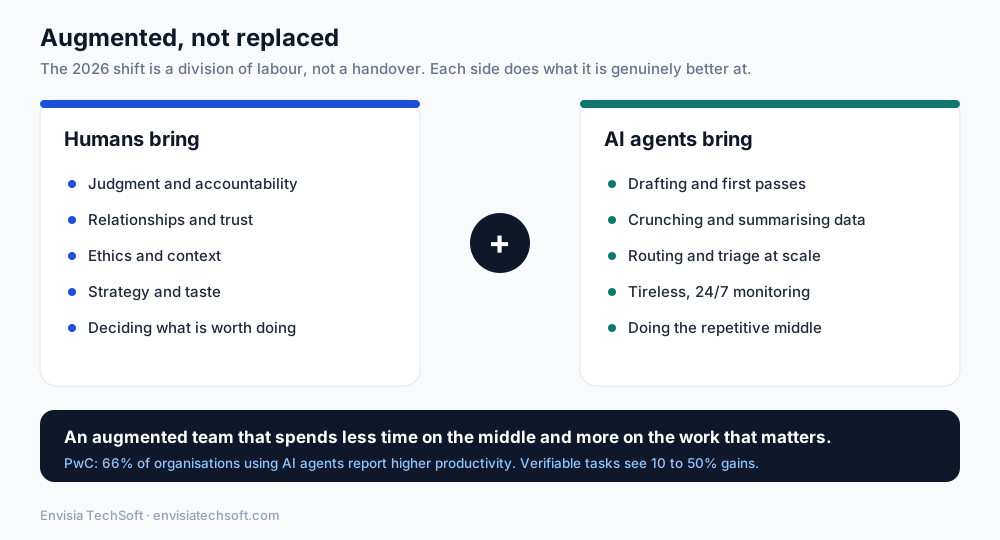
The new division of labour
The reason this works is that humans and AI are good at genuinely different things, and pretending otherwise is how you get bad deployments. Play to each side's strengths and the pairing beats either one alone.
Here's the split as it's settling out in practice:
| Humans are still better at | AI agents are better at |
|---|---|
| Judgment and being accountable for a call | Drafting fast first passes |
| Relationships, trust, reading a room | Crunching and summarising data |
| Ethics and understanding context | Routing and triaging at scale |
| Strategy, taste, deciding what matters | Tireless monitoring, around the clock |
| Knowing which problem is worth solving | Grinding through the repetitive middle |
Look down that left column. Every item is something you'd struggle to hand to a machine, and every item is the part of a job that people usually find most meaningful. That's the quiet upside of this shift. When the AI absorbs the drudgery, the human keeps the judgment, the relationships, and the interesting decisions.
The jobs question, honestly
It would be dishonest to pretend nothing gets displaced. Some tasks, and some roles built entirely on those tasks, will shrink. But the aggregate picture is not the apocalypse the headlines sell. The World Economic Forum projects 170 million new jobs created by 2030, outnumbering the roles displaced. Work changes shape faster than it disappears.
And genuinely new roles are appearing, ones that didn't have a name a few years ago:
- AI trainers, who fine-tune and shape models for a specific business.
- System ethicists, who keep AI decisions aligned with human values and the rules.
- Strategic collaborators, who turn AI-driven insight into new products and market moves.
The pattern in history holds: automation removes specific tasks, and people move up the value chain toward the work that requires the things machines don't have. This time is faster and more visible, but the shape is familiar.
The rise of the digital peer
The technical change driving all this is that AI has graduated from assistant to something closer to a colleague. Earlier tools waited for a prompt and gave you a reply. The agentic AI of 2026 can take a goal, break it into steps, use tools across your business software, and actually carry a task through, checking in rather than being micromanaged.
That's why the metaphor has moved from "assistant" to "digital peer." You don't prompt a peer line by line. You delegate an outcome, set the guardrails, and review the result. Which, if you think about it, is exactly how you'd work with a capable junior colleague. The management skill and the AI skill are converging.
What this means for you and your team
If you lead a team, the practical implications are clearer than the hype suggests:
- Redesign roles around judgment, not tasks. Ask what your people are uniquely good at, push the repetitive middle to AI, and rebuild the job around the human part.
- Treat working with AI as a skill to be taught. Delegating to an agent, checking its work, and knowing when to overrule it are learnable, and the teams that train for it pull ahead of the teams that don't.
- Keep a human accountable for every decision that matters. Augmentation works because a person owns the outcome. That accountability is a feature, not a formality.
The uncomfortable truth and the reassuring one are the same sentence: your job will change. But the direction of that change, for most people, is toward doing more of what humans are actually good at and less of the grind. The winners won't be the people who resist AI or the ones who blindly hand everything to it. They'll be the ones who get good at the collaboration itself.
That's a skill worth building now, while it's still early. It's also, not coincidentally, exactly the kind of thing we help teams learn.
Sources
Frequently asked questions
- Will AI replace jobs or augment them?
- For most roles the near-term reality is augmentation rather than wholesale replacement. AI takes over specific tasks within a job while people handle judgment, context, and accountability. Some roles shrink, but the more common change is the shape of the work rather than its disappearance.
- What does human-AI collaboration look like day to day?
- It looks like AI handling drafts, summaries, research, and repetitive steps while a person directs the work, checks the output, and makes the calls that carry responsibility. The AI acts more like a fast junior colleague than an autonomous replacement.
- How should I prepare my team for working with AI?
- Focus on the skills AI does not have: framing problems, judging quality, and owning outcomes. Teach people to delegate the right tasks to AI and to review its work critically, rather than either avoiding it or trusting it blindly.
- What is a digital peer or digital coworker?
- It is an AI system that works alongside people as a persistent collaborator rather than a one-off tool, holding context across tasks and taking on defined pieces of work. It behaves more like a teammate you delegate to than a search box you query.