Here is how building an AI agent usually goes. You have a good idea, an internal copilot, a support agent, a research assistant, and you're excited. Then reality sets in. You wire up the model SDK. You bolt on a vector store for memory. You hand-code the tool calls. You add retry logic, then guardrails, then some logging so you can see what on earth the thing is doing. Two weeks later you finally run it end to end and discover the idea needed a different prompt strategy entirely. Back to the start.
That gap, between having an idea for an agent and knowing whether it actually works, is where most agent projects quietly die. Not because the idea was bad, but because the cost of finding out was too high. AgentLab is the product we built to collapse that gap.
What AgentLab actually is
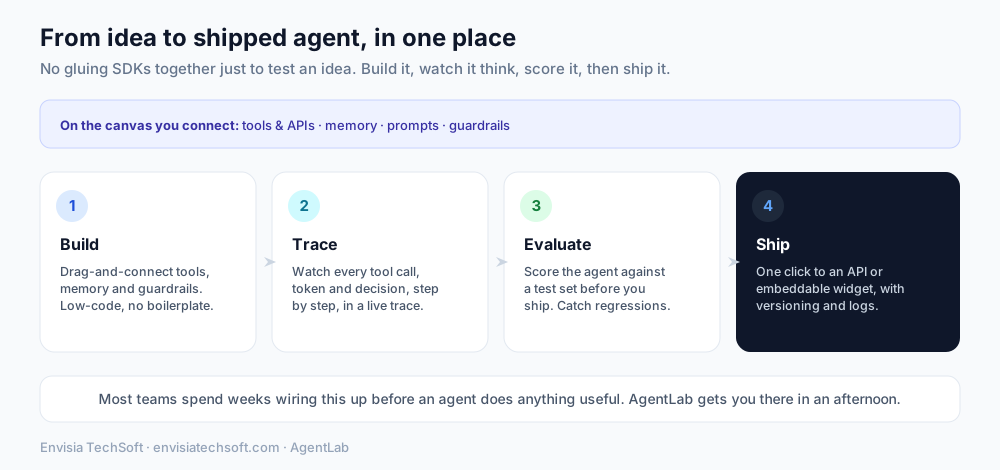
AgentLab is a low-code environment for designing, testing, and deploying LLM agents. Instead of gluing SDKs together to test an idea, you compose the agent on a visual canvas: connect the tools and APIs it can use, give it memory, write its prompts, and set its guardrails. Then you watch it work, step by step, in a live trace. When it's good, you ship it.
That's the whole loop, and the point is that it's one loop, in one place, rather than a scattered pile of scripts you're afraid to touch.
The four things it does well
1. Build on a canvas, not in boilerplate
The visual agent builder lets you compose tools, memory, and prompts by dragging and connecting, with no scaffolding to write. Want the agent to be able to search your docs, call your internal API, and remember the conversation? Connect those pieces and you have a working agent to poke at, in minutes rather than days. The goal is to make the cost of trying something close to zero, because that's what lets you find the version that works.
2. Watch it think, in a live trace
The single most frustrating thing about agents is that when they go wrong, they go wrong silently. AgentLab's live reasoning traces show every tool call, every token, and every decision the agent makes, laid out step by step. When an agent picks the wrong tool or misreads a result, you see exactly where and why, instead of staring at a bad final answer and guessing. Debugging an agent stops being archaeology.
3. Score it before you ship it
This is the part teams skip and then regret. An agent that looks great on the three examples you tried by hand can fall apart on the fourth. AgentLab has built-in evaluation: score any agent against a test set before it goes live, so you catch regressions early instead of in front of a customer. It turns "it seemed to work" into a number you can actually track as you change prompts and models. (If you've read our take on why detectors and demos mislead, you already know the value of measuring instead of eyeballing.)
4. Ship it in one click
When an agent is ready, AgentLab publishes it as an API or an embeddable widget, with versioning, logging, and observability built in. No separate deployment project. The same environment where you designed and tested the agent is where it goes to production, so you always know which version is live and how it's behaving.
Where teams are using it
AgentLab is aimed at the messy, early part of agent work, where you're still figuring out whether an idea is worth real engineering time. A few patterns we see:
- Prototype an internal copilot before committing an engineering team to it. Prove the concept in an afternoon, then decide.
- Stand up a customer-facing support or research agent without building the whole harness from scratch.
- Settle a model-and-prompt argument with data. Try different models and prompt strategies against the same eval set and see which actually wins for your task.
- Give non-engineers a safe sandbox. Let product folks and analysts experiment with agentic AI without touching production or writing code.
It fits engineering teams, AI and ML leads, product teams, and innovation labs, basically anyone who has more agent ideas than time to hand-build each one.
Why we built it
We build custom AI systems for clients, and we kept hitting the same wall ourselves: the slowest part of shipping an agent was never the interesting part. It was the plumbing. Wiring tools, standing up memory, adding guardrails and logging, the same undifferentiated work every single time, before we could even learn whether the agent was any good.
AgentLab is that plumbing, done once and made reusable, so the time goes into the part that matters: the design, the evaluation, and the judgment about whether the agent is actually ready. It reflects how we think agents should be built in general, which is the same principle running through our writing on context engineering and agent security: make the reasoning visible, measure before you trust, and keep tight control over what the agent can touch.
Try it
AgentLab is currently in beta. If your team has an agent idea sitting in the "we should build that sometime" pile, this is the fastest way to find out whether it's worth building for real, before you spend a quarter on it.
Have a look at AgentLab, or get in touch and we'll walk you through it with your use case in mind. It's built by Envisia TechSoft, the same team behind our AI training and the custom AI products we ship.
Frequently asked questions
- What is AgentLab?
- AgentLab is Envisia's platform for building and shipping AI agents quickly. You design an agent on a visual canvas instead of writing boilerplate, watch it reason through a live trace, score it against test cases before release, and deploy it in one click.
- How is AgentLab different from building an agent from scratch?
- Building an agent by hand means wiring up orchestration, tool calls, memory, and evaluation yourself, which usually takes weeks. AgentLab gives you the canvas, tracing, scoring, and one-click deployment out of the box, so a working agent goes from idea to shipped in an afternoon.
- Can I test an AI agent before putting it in front of users?
- Yes. AgentLab lets you score an agent against a set of test cases and inspect a live trace of its reasoning, so you can see where it goes wrong and fix it before you ship rather than after.
- Who is AgentLab for?
- It is aimed at teams that want to build internal or customer-facing AI agents without standing up an entire engineering stack first, from product teams prototyping ideas to businesses shipping real workflows.