Retrieval-augmented generation is the standard way to make an AI answer from your own documents, and the basic version is genuinely easy to stand up. Embed the user's question, search your document store for the closest chunks, paste them into the prompt, and let the model answer. For a small, clean set of documents, that "naive RAG" works fine.
Then reality shows up. The answers start missing obvious things. Someone searches for a product code and gets nothing because the code isn't semantically similar to anything. A question that spans three documents gets a confident answer built from one. The system retrieves five chunks, and two of them are noise that quietly derails the model. This is the point where you graduate from naive RAG to advanced RAG, and the good news is that it's a series of specific, well-understood upgrades, not a rewrite.
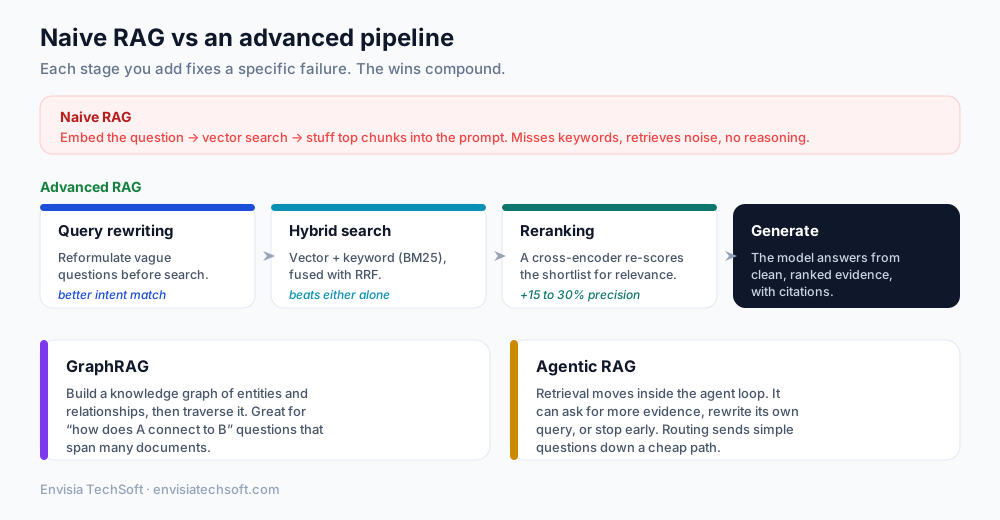
Why naive RAG hits a wall
The core weakness is that naive RAG leans entirely on one thing: semantic (vector) similarity. That's powerful, but it's also blind in specific ways.
- It misses exact terms. Vector search is about meaning, so it can whiff on a part number, an error code, or a specific name that doesn't have a close semantic neighbour.
- It retrieves noise. "Grab the top five closest chunks" often includes a couple that are close in vector space but irrelevant to the actual question, and those distract the model.
- It can't reason across documents. If the answer requires connecting facts from several places, a single similarity search rarely assembles them.
- It takes the question literally. A vague or badly-phrased query retrieves vague, badly-matched results.
Each of these has a fix. You don't need all of them, and adding them thoughtfully is the whole skill.
The core upgrades, in the order they pay off
These three form the backbone of almost every serious RAG system in 2026. Add them roughly in this order.
1. Query rewriting
Before you search, clean up the question. A query rewriting step reformulates a vague or underspecified question into something the retrieval system can actually match. "What's our policy on this?" becomes a fuller, more specific query. It's cheap, it happens before retrieval, and it lifts the quality of everything downstream because you're no longer searching on a fuzzy input.
2. Hybrid search
This is the big one. Instead of relying on vector search alone, run it alongside old-fashioned keyword search (BM25) and combine the results, typically with a method called Reciprocal Rank Fusion. Vector search catches meaning; keyword search catches the exact part number vector search missed. Fused together, they reliably beat either one on its own. If you make a single upgrade to naive RAG, make it this one.
3. Reranking
After retrieval, before the model sees anything, run the candidates through a second, more careful model called a reranker (a cross-encoder) that scores each one for genuine relevance to the question. It's slower per document, which is why you only run it on the shortlist, but it's far more accurate than the initial search. Reranking typically improves the precision of your top results by 15 to 30%, which directly translates to fewer noisy chunks reaching the model and fewer wrong answers.
Here's the whole core pipeline and what each stage buys you:
| Stage | What it does | The failure it fixes |
|---|---|---|
| Query rewriting | Reformulates the question before search | Vague queries returning vague results |
| Hybrid search | Vector plus keyword, fused | Missing exact terms and codes |
| Reranking | Re-scores the shortlist for relevance | Noisy, irrelevant chunks in the context |
| Generation | Answers from clean, ranked evidence | The model finally has good material |
When you need the heavier machinery
The three upgrades above handle most cases. Two more patterns exist for when they aren't enough, but treat them as tools for specific problems, not defaults.
GraphRAG is for questions where the answer lives in the connections between things. Instead of retrieving text chunks, it builds a knowledge graph from your documents, entities as nodes and relationships as edges, and traverses it to answer. It shines on "how does A relate to B" questions that span many documents, the kind naive RAG structurally cannot handle. The trade-off is that building and maintaining the graph is real work, so reach for it when relationship questions are central to your use case.
Agentic RAG moves retrieval inside the model's reasoning loop rather than in front of it. Instead of retrieving once and answering, the agent can search, decide it needs more, rewrite its own query, search again, and stop when it has enough. It's more capable and more expensive, so the smart pattern is adaptive routing: send simple questions down the cheap path and reserve the full agentic treatment for the queries that genuinely need it.
How to actually approach this
The mistake teams make is jumping straight to GraphRAG or agentic RAG because they sound advanced. Don't. The 2026 best practice is to match the complexity of the pipeline to the complexity of the question, and most questions are simpler than they look.
A sensible path:
- Start with naive RAG and see where it actually fails. Don't guess, measure.
- Add hybrid search and reranking. These two fix the majority of real-world retrieval problems and are worth doing almost always.
- Add query rewriting if your users ask vague or messy questions.
- Only then consider GraphRAG or agentic RAG, and only for the specific query types that need them.
And whatever you build, set up an evaluation harness from day one so you can tell whether each addition genuinely helped. RAG quality is measurable, and the teams that measure it end up with systems that work, while the teams that add fashionable components on vibes end up with expensive pipelines that answer no better than the simple version did.
Advanced RAG isn't about using every technique. It's about knowing which failure you're fixing, and adding exactly the piece that fixes it.
Sources
Frequently asked questions
- What are advanced RAG techniques?
- The core advanced techniques are query rewriting (cleaning up the question before search), hybrid search (combining vector and keyword search), and reranking (re-scoring results for relevance before the model sees them). Beyond those sit GraphRAG for relationship-heavy questions and agentic RAG, which moves retrieval inside the model's reasoning loop.
- What is hybrid search in RAG?
- Hybrid search runs semantic vector search alongside old-fashioned keyword search (BM25) and fuses the results, usually with Reciprocal Rank Fusion. Vector search catches meaning while keyword search catches exact terms like part numbers and codes, so together they reliably beat either one alone. It is usually the single highest-value upgrade to naive RAG.
- What is reranking and why does it matter?
- Reranking runs your retrieved candidates through a second, more careful model (a cross-encoder) that scores each one for genuine relevance before the model uses them. It typically improves the precision of your top results by 15 to 30%, which means fewer noisy chunks reach the model and fewer wrong answers come out.
- When do you need GraphRAG?
- Use GraphRAG when the answer lives in the connections between things rather than in any single document, for example how one entity relates to another across many sources. It builds a knowledge graph and traverses it instead of retrieving text chunks. The trade-off is that building and maintaining the graph is real work, so reach for it only when relationship questions are central.